SUPER MARIO BROS.: FROM PLAYER TO VIEWER
January 15, 2026You found a pepperoni secret! If you needed to know why studying media analysis is so fun, it's because you get to write some really stupid papers. So I chose to write this paper and it was recieved so well I have decided to share it here. Enjoy!
The year 2023 saw the release of a brand new animated Super Mario adaptation released by Illumination, a film rather plainly named The Super Mario Bros. Movie. Leading up to the release of this commercial success is a long history of Super Mario Bros. media, a story world originating out of platformer video games produced by Japanese game studio Nintendo. Super Mario as a character and as a franchise is now renowned for featuring some of the most recognizable video game iconography of all time, and Mario as a brand and as a character is popularized for a range of commercially successful games for all ages. What is a little less attributed to this highly popular character is the existence of an older feature-length Mario film, Super Mario Bros.: The Movie, released in 1993 and directed by duo Morton & Jankel. This original movie came to break conventions and put a stop to Mario’s stellar track record, as a dark and dissonant version of the Mario world hit the big screen to critical backlash. What became an infamously bad movie during its time is now a point of fascination and cult interest. What was so strange about this original Mario movie, and how does it compare to its 2023 counterpart?
The paper will begin by discussing intermediality and the features that become apparent when the modalities of film and games are juxtaposed. In this section, games and film are broken down into their basic qualities, looking at what occurs during the transformation from game to film. Following the establishing of the modalities of these two films will be an analysis of the Mario franchise as a transmedial story world, alongside what distinguishes them as interesting examples of adaptation. What makes an analysis of these two movies in relation to their video game counterpart particularly interesting is how much they rely on their original story worlds. Intermedially, they rely on a community of gamers and a range of games to make sense. This is communicated aesthetically and textually, as well as through narrative choices and sound (Jensen, 2016). Together, a Mario franchise establishes itself by its very particular modalities, affordances and recognizable features. What soon appears when looking at these two movies is two very different interpretations and executions of this intermediality. More or less successfully, each movie has picked out features that construct their very own version of the Mario world, sometimes in aspects that make one movie more unrecognizable from the other. As this paper continues to outline these differences, an overview of what defines a Super Mario story world will begin taking shape. Transferring these particularities to film is where some of the large discrepancies start to appear between the 1993 and 2023 versions. The analysis of its effects begin by establishing their respective modalities.

Modalities
Film and video games both share a number of basic modalities, with video games having a slight upper hand in terms of complexity. A video game as a basic media product utilizes the material and sensorial modalities, at the same time as it makes use of the spatiotemporal and semiotic (Jørgensen, 2024, p. 3). Cinematic movies are in comparison not controlled by a player, resulting in that the medium of film loses the sensorial modality pertaining to the feeling of buttons. In this regard, games is the more qualified media type as well as being a highly multimodal form of media, both for the player to experience and for the developer to create (Hawreliak, 2018, pp. 6-7). Adapting a game to a film could therefore be argued to lose more modalities than it gains, which means that narrativity is forced to become stronger.
The major change that occurs when adapting the Mario franchise in particular is this same transformation in the narratorial modalities: text and speech. This transformation is notable due to the fact that the original Mario franchise is dependent on gameplay to make narrative sense. Narrativity itself consists of several modes that communicate and make meaning, some of which in the video game context is text, lore, interface, image, sound and haptic feedback (Hawreliak, 2018, pp. 45-74). The Mario franchise of games does not utilize all of the modes as outlined by Hawreliak (2018). Examples of missing modes are for instance text, lore, speech and in some instances cinematic imagery. These missing components reflect both the child-friendly and accessible nature of these video games as well as its worldwide appeal. You do not need to know any particular language to be able to enjoy this franchise, as its iconography alone establishes many of its features. In turn, other modalities within the Super Mario Bros. franchise of games are instead stronger, and in the process its very particular media identity is strengthened. In its most basic form, the Mario plot plays out while the hero saves the princess, and this task plays out in a colorful world full of smiling characters and an exciting soundtrack. This gives the Mario franchise a strong image and music-based identity, where the player can visually identify the task and press buttons to receive the haptic feedback of running and jumping.
The narrative of the platforming genre of Mario games takes place as the player moves from one level to the next to get closer to the kidnapped princess. During this process, the players themselves fill the gaps between the start and the end of the story, constructing their own narrative as they navigate a variety of levels. This is not possible to reflect in film, and in the process the medium has to innovate in order to construct a Mario story. This particular lack of lore and speech is in direct conflict to the movie as media and the modalities that make cinematic film a qualified media product. A modern film is expected to, among other things, have “a director and a script (or another sort of plan) behind the composition, and certain communicative and aesthetic parameters,” (Jensen & Salmose, 2021, p. 28). What occurs here is a challenge for the director of a Mario cinematic movie: What is a movie without the presence of a narrative? As two movies with a number of very different creators and a 30-year age gap along the way put emphasis on how “It is … not self-evident that different narratives within one and the same media type depend on exactly the same basic media traits,” (Ellerström, 2019, p. 46).
Both Super Mario Bros. movie examples have applied very diverse strategies while constructing their adaptations of the story worlds where their reinvented Mario characters can act. Jørgensen (2024, p.16) describes the strategy utilized to fill these narrative gaps by the term supplementary adaptation, this being only one of the tropes that occur when games attempt to adapt game logic to cinema. Starting with what the two films have in common, Mario’s two movie counterparts are both given a voice and a more elaborate personality. This is in contrast to the game, where he has become known as a plain protagonist who expresses himself through “wahoo’s”. In one movie he is played by actor Bob Hoskins, while in another his animated avatar is voiced by Chris Pratt. As a different kind of Mario, the movies mediate a relatable protagonist with a larger range of problems, such as a struggling plumbing business, or a strained relationship with his father.

The movie watcher is not encouraged to progress to the next level, but to experience a character moving through fantastical worlds and overcoming their problems. As actors, Hoskins and Pratt also contribute to breathing brand new life into Mario as a character, as the distinct cadence and intonation of each actor applies a personality separate from the high-pitched game version. Hoskins could be considered to lean heavier toward a Mario as a gruff blue-collared New Yorker, as Pratt acts softer and with a carefully optimistic attitude. Interestingly enough, the movie interpretations of Mario’s speech are more similar to each other than to the original game. The second feature that both films have in common is the game logic of teleporting, or switching between dimensions—either through a pipe or a portal. This adaptation is an example of a procedural mode of adaptation, mirroring a game-specific function that changes levels (Jørgensen, 2024, p. 16). Finally, both plots are also fundamentally about rescuing a person trapped in this alternate mushroom reality. In the 1993 movie this is the emblematic quest for a princess, while Illumination’s 2023 story attempts to innovate by giving Mario’s brother—Luigi—the role of the damsel in distress.
Morton & Jankel’s 1993 film would later become infamous for its lackluster storytelling and its strange interpretation of both the Mario story world and its characterization. In other words, it both fails to depict accurate references to the games themselves, and instead puts too large of an emphasis on supplementing the original story world (Jørgensen, 2024, p. 16). One reviewer states that “This film's two directors and three screenwriters have clearly tried hard to breathe life into their nonstory, to the point where the film's intensity seems more crazy than cynical,“ (Maslin, 1993). The film attempts to break down the Mario narrative into its simplest components—the hero saving the princess—all the while it reconstructs the very fundamentals of its world. Instead of a bright and colorful Mushroom Kingdom as seen in the games at the time, this world takes place in an alternate universe where humanity has evolved from dinosaurs instead of from apes. With gritty and dark set design and horrifying practical effects, this Mario world is not one you would like to spend a very long time in.
Following Morton & Jankel’s critical failure that was the first feature length Mario Bros. film, it took 30 years until Nintendo was willing to revive the franchise outside the realm of video games and merchandise. This eventually resulted in Illumination’s 2023 animated movie, The Super Mario Bros. Movie, which saw critical success. A prominent first recipe for success here is the fact that this movie is fully animated, a medium of which immediately evokes the game series concurrent 3-dimensional style. With a few exceptions, the art style of this movie is reminiscent of Super Mario Odyssey (2017) or the Super Mario Galaxy games. The universal reaction to this movie was its faithfulness to both tone and style, and its extremely accurate depiction of the Super Mario universe as a whole. Juxtaposing these two movies, the art style itself reveals two completely different sides of the same coin. As movies about games, the 2023 version seeks to evoke Mario as a gamified universe by bringing forth very precise modalities, an approach which makes its antecedent look highly confused in the process. As pointed out by MacDonald (2023) of The Guardian, “Some criticised Mario’s nonsensical backstory, but Mario barely has a backstory to begin with. The character exists as a context-free embodiment of the joy of movement.” This brings forth the point that Mario as a platformer game is also represented in Illumination’s film. While existing simply for the sake of eye candy, many recognizable elements are taken straight out of a Mario Bros. level and established as a natural feature of its cinematic story world.
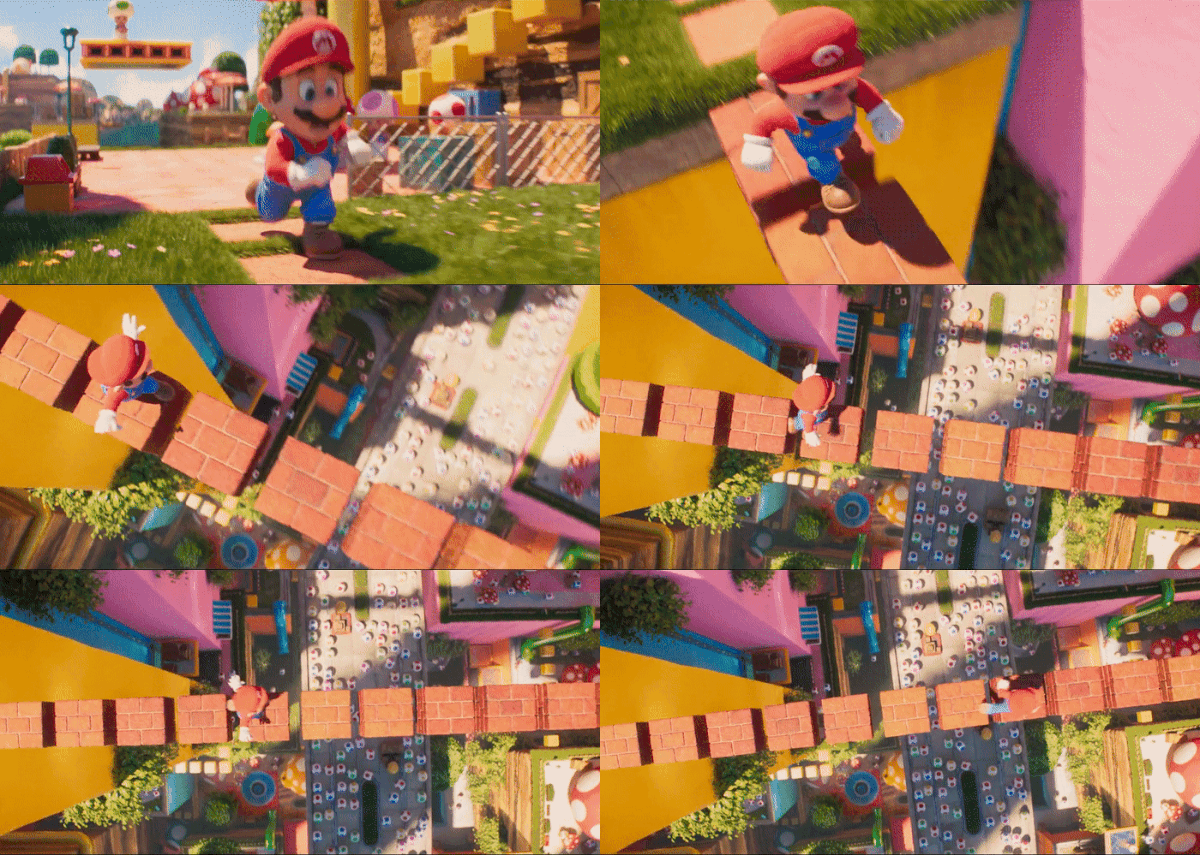
This firmly places Illumination’s movie as a gamified world without buttons, a feature that is sorely missing in Morton & Jankel’s interpretation. That being said, it is equally important to take note of what the Mario franchise itself has become during the 30-year gap between these two movies. More importantly, the 1993 film must be understood as being produced before Super Mario as a game franchise had become 3D. This resulted in limitations in terms of adaptation, as the only way to accurately mediate a faithful Mario movie at the time would have been a 2D animated movie. This concept was however not new for the franchise, when realizing that the animated cartoon series were ongoing throughout the 90’s.
Transmediation and Story World
Looking closer at Morton & Jankel’s 1993 Super Mario Bros. movie reveals some strange changes that start to make sense of its failed adaptation. This “failure” is another way to look at transmediality and what the movie does not successfully transmediate out of its video game source. The 1993 movie first rewrites several key components of the original Mario franchise, the most extreme of which might be the live action representations of its entire cast and its reliance on realistic practical effects. The various redesigns transform the impression of several of its characters: Bowser is a human president, and Yoshi is taken straight out of Jurassic Park.
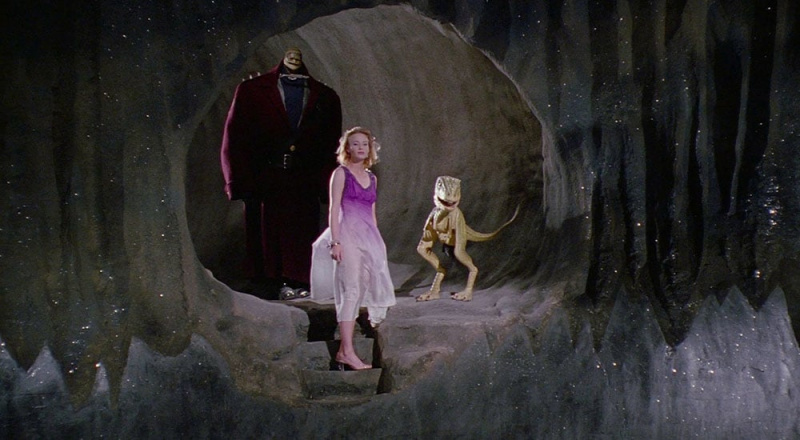
These were features that would never again reoccur in the franchise, and its approach might even be considered an appropriation of its story world. The 1993 movie can however not be described as entirely unsuccessful as an adaptation, as both movies transmediate a few identical themes. This primarily happens through its leading characters: Mario and Luigi, iconography such as the mushroom, alongside recognizable snippets of music. This is primarily for the purpose of franchise-building and the creation of a connected narrative across the different media types (Aksander et al., 2021, p. 267). Both movies make use of vastly different strategies in communicating their world in this regard.
When discussing a Mario Bros. movie in particular, it has already been established that the original franchise is extremely light on narrative. Starting by looking closer at the story world highlights some of the possible narrative strategies of this story-light franchise, displaying what can be effectively transmediated and what can not. The construction of a Mario related narrative first hinges on that a perceiver recognizes the franchise and its many distinguishable features. Whether that be mushrooms or question-mark blocks, the franchise consists of recurring elements that come together to create its brand identity. Without this context, the Mario world as a film is simply interpreted as an adventure flick starring a mustachioed plumber and his wacky sidekicks. This does not necessarily mean that the film would be unsuccessful out of context, but it would mean that its role as a Super Mario story is irrelevant to the experience. Its original role as the representation of a particular franchise is in fact one of the primary motivating factors behind the creation of an adaptation. A successful transmediation both promises movie creators a pre-established audience of fans, as well as a shortcut toward commercial success (Aksander et al., 2021, p. 274). This commercial incentive has both faced criticism and seen the intended effect for both movies, especially in the case of Illumination’s version.
The success of Illumination’s Mario movie has led to the continuation of a franchise of movies and as such the continuation of a very specific brand identity. Interestingly, this means that the transmediated story world as established by Illumination’s version is going to continue informing its next installment. This in turn establishes a new story world. One of these interesting distinctions that made the 2023 movie so successful can be found on account of style and color. Mario as a franchise begins to establish itself when it comes to color in particular, with the logo alone being extremely saturated and based on primary colors. These colors, red, blue and green, have been a staple of its story world ever since Mario first hit the arcade. While at first appearing to serve a simple role as a colorful cartoon movie, its contrast with its murky 1993 counterpart proves color as a fundamental element of the Mario franchise. The second important component is the animation style, a look which immediately evokes modern Mario games in high fidelity. When placing Mario from 2023 next to his video game counterparts from 1993, he remains recognizable as the same iconic character. The same thing could not be said for Bob Hoskins rendition, a valiant attempt that only came close after stepping into the iconic red and blue overalls by the very end of the movie.
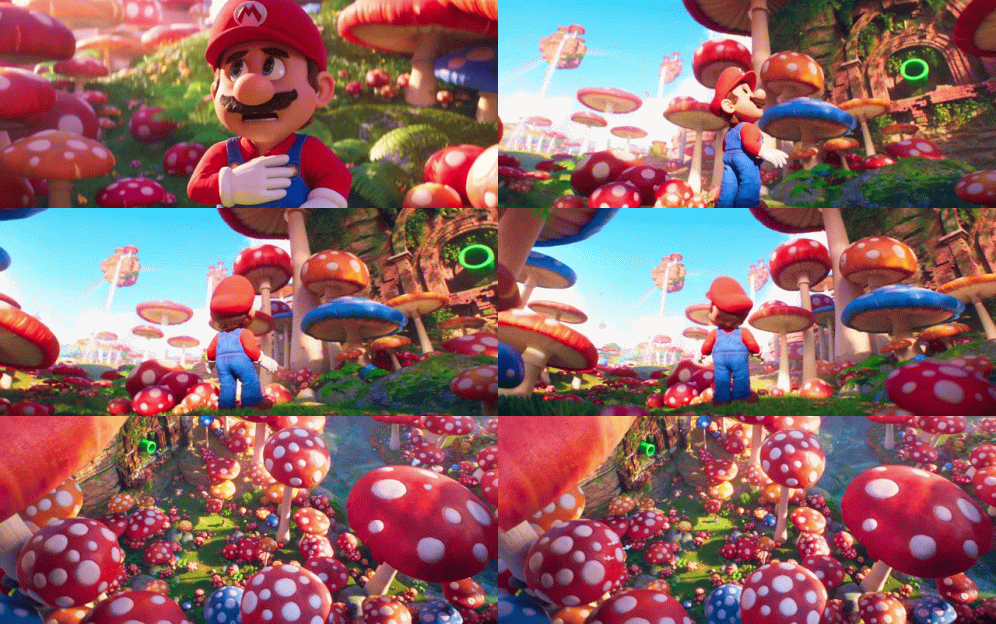
These examples or criticism toward the older movie do not prove that Illumination’s approach was the pinnacle of transmediation of this video game franchise. Several changes in narrative, world and characterization have changed rather drastically in this example, as well. Some of these are for instance the brother’s return to Brooklyn, where brand new characters are introduced. This includes Mario and Luigi’s parents and extended family—characters never before canonized. As much as some fans appreciated its authenticity, Illumination’s movie also introduced a few problems in terms of its role as a film. One particularly critical reviewer explains that “If your movie relies solely on audience recognition of its characters and their established traits, it’s not actually a movie – it’s a primetime clipshow,” (Van-Wall, 2023). The overall impression of this movie is quite simply that it was very closely monitored to be as Mario-like as possible during its production. This becomes apparent in its reliance on references, its cute animation style, and its uncomplicated story. This swings back into the issue of commercialization of the brand, and transmediation as a product of financial incentives.
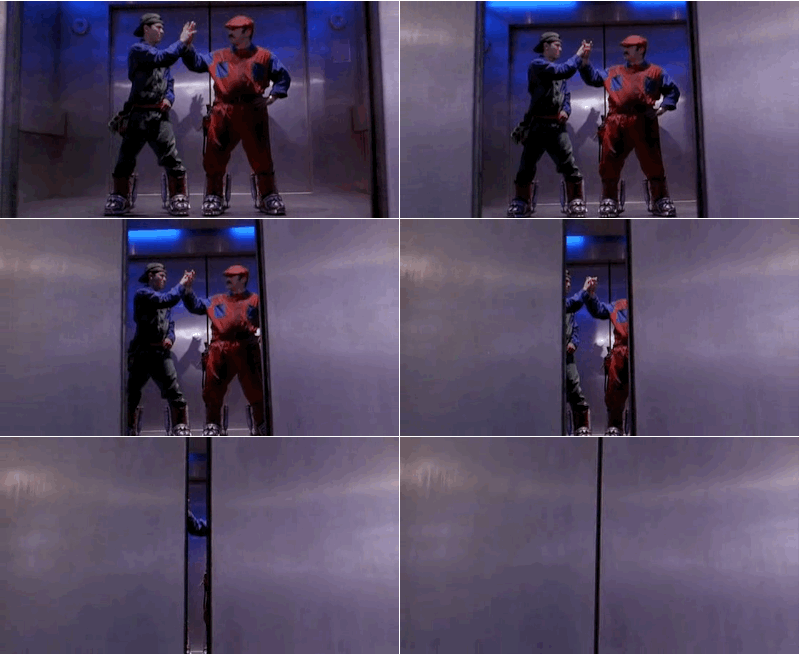
The argument of financial incentive is what makes Morton & Jankel’s Mario movie so interesting and iconic. As an unrecognizable universe with a familiar Italian name tacked on top, it is considered an entirely separate franchise only in retrospect. On its own, it is a delightfully strange cult classic and a product that could have only come out of its time and through the decision of giving a pair of directors free reign over an immensely popular franchise. Mario and Luigi play together in this movie as the Mario and Luigi of 1993, who could have transmediated their future selves if the movie had seen more commercial success. Like its own plot, it currently exists as an alternate dimension where the Mario franchise ended up communicating a gritty underground reality where humanity stemmed from dinosaurs. As it currently stands, it is instead the carefully curated 2023 animated version that continues the franchise and will inform the Super Mario brand through its future installments.
Conclusion
This paper has outlined Super Mario as a franchise and as several forms of media product. As a Mario product moves from game to movie it both loses modalities and the basic media types afforded by video games, all the while it elaborates on modalities such as the textual and narratorial. As a mute icon of platforming games, Super Mario as a movie character goes through a transformation as he becomes the protagonist of his own movie. This characterization is interpreted vastly differently depending on which movie he has acted in. As his live-action Bob Hoskins persona, we find a Mario in a universe completely removed from its in-game counterpart. As an animated figure out of an Illumination movie, Mario instantly becomes recognizable as an accurate transmediation of his own media franchise. As products of commercialization, however, both of these movies make their own attempts to recreate its original media worlds. This successful transmediation can either be interpreted as being indicative of a good film, or as a symptom of the homogenization of media brands. As a not-quite-Mario movie, Morton & Jankel’s Super Mario Bros.: The Movie shines an interesting light on adaptation without transmedial limits.
References
Aksander, M., Gutowska, A., Makai, P.K. (2021). Transmedial storyworlds. In: J. Bruhn & B. Schirrmacher (Eds.), Intermedial Studies: An Introduction to Meaning Across Media. Routledge. https://doi.org/10.4324/9781003174288
Ellerström, L. (2019). Transmedial Narration. Palgrave Pivot Cham. https://doi.org/10.1007/978-3-030-01294-6
Hammeleff Jørgensen, I.K. (2023). The Qualified Medium of Computer Games: Form and Matter, Technology, and Use. In: J., A. López-Varela, M. de Paiva Vieira (Eds), The Palgrave Handbook of Intermediality. Palgrave Macmillan, Cham. https://doi.org/10.1007/978-3-030-91263-5_59-1
Hawreliak, J. (2018). Multimodal semiotics and rhetoric in videogames. Taylor & Francis Group.
Jensen, K.B. (2016). Intermediality. In: K.B. Jensen, E.W. Rothenbuhler, J.D. Pooley and R.T. Craig (Eds.), The International Encyclopedia of Communication Theory and Philosophy. https://doi.org/10.1002/9781118766804.wbiect170
Jensen, S.K. & Salmose, N. (2021). Media and modalities – Film. In: J. Bruhn & B. Schirrmacher (Eds.), Intermedial Studies: An Introduction to Meaning Across Media. Routledge. https://doi.org/10.4324/9781003174288
Macdonald, K. (2023, April 12). Pushing Buttons: The Super Mario Bros Movie is just fine – but what else did you expect? The Guardian. https://www.theguardian.com/games/2023/apr/12/pushing-buttons-super-mario-bros-movie?CMP=share_btn_url
Maslin, J. (1993, May 29). Review/Film; Plumbing a Video Game to Its Depths. New York Times. https://www.nytimes.com/1993/05/29/movies/review-film-plumbing-a-video-game-to-its-depths.html
Vann-Wall, S. (2023, April 5). The Super Mario Bros. Movie review: It’s-a mess! Screenhub. https://www.screenhub.com.au/news/reviews/the-super-mario-bros-movie-review-2609855